Axiora Medical
Titanium Mesh For Cranial Repair is not a simple catalog purchase. The choice can affect how well an implant fits a cranial defect, how clearly its edges are finished, and how reliably the supplier supports clinical planning. For surgeons and procurement teams, small details matter: mesh thickness, pore geometry, contouring options, documentation, and consistent production quality. A polished product page cannot answer every question.
Craniofacial surgeon Dr. Michael Yaremchuk’s published work offers a useful clinical lens for evaluating reconstruction choices. A guiding statement for this comparison is: “Choose the implant around the defect, not the catalog.” This is an editorial paraphrase, not a verified verbatim quotation. It captures an important point: supplier claims should be checked against specifications, quality records, and the needs of the clinical team. Fit matters. So does evidence.
This guide reviews ten suppliers of titanium mesh for cranial repair, focusing on product range, customization, manufacturing transparency, and practical support. It does not treat a supplier ranking as a substitute for clinical judgment or local requirements. Readers should verify current certifications and product documentation directly with each manufacturer. That step can feel tedious, yet it prevents assumptions from doing the work of evidence. Supplier information also changes, and this review may not capture every regional difference. Use it as a starting point for careful questions, not a final purchasing decision.
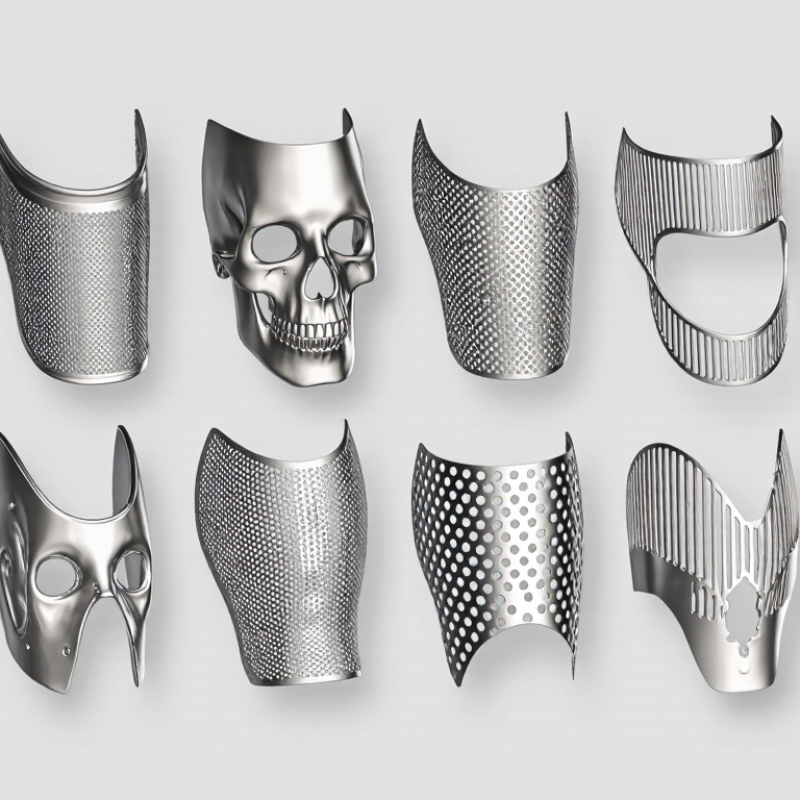
Cranial titanium mesh is a perforated implant used to cover or reconstruct skull defects. Its openings let clinicians shape the plate and secure it with small screws. The mesh must follow the patient’s bone contour, especially around the forehead, temples, and orbital margins. Even a slight edge mismatch can create pressure beneath thin scalp tissue. Preoperative CT images help teams assess the defect and plan the implant’s shape. They do not replace careful intraoperative fitting.
Material data helps explain why titanium is used, but it cannot predict an individual outcome. ASTM F136 specifies requirements for wrought Ti-6Al-4V ELI implant alloy. ASM Handbook materials data place its density near 4.43 g/cm³ and elastic modulus around 110 GPa. These figures describe the alloy, not the performance of every mesh design. Thickness, hole pattern, fixation points, and bending can all affect stiffness and handling. A rigid plate may maintain shape, yet excessive stiffness can concentrate loads at its edges. That comparison is useful, but incomplete: bone and soft tissue respond differently, and clinical results depend on more than material properties. Mesh selection should consider defect size, available tissue coverage, imaging needs, and the surgeon’s reconstruction plan.
Cranial repair mesh begins with a careful reading of the defect and the surrounding anatomy. Design teams may use medical imaging to build a three-dimensional model, then shape a digital mesh around the required contour. The model helps define coverage, screw-hole positions, and clearance near sensitive structures. Fit matters. A mesh that looks smooth on screen may still need adjustment after physical forming.
Manufacturing methods vary. Thin titanium sheet can be laser-cut, while some designs may be produced through additive manufacturing. In either case, engineers control thickness, pore pattern, edge finish, and fixation features. Small details matter. Rounded edges can reduce sharp contact points, and consistent openings help keep the structure lightweight while supporting tissue access. After shaping, parts undergo cleaning and dimensional inspection; surface condition and material traceability also need attention. Sterilization is handled under controlled, validated procedures.
The final design is a compromise between strength, contour, and practical handling. A very open pattern may reduce material but can feel less rigid; a thicker plate may be harder to contour. These trade-offs deserve review, not assumptions. Manufacturing records and inspection results help suppliers show that each mesh matches its specifications, though no digital model can capture every variation in real anatomy.
Selecting a cranial-repair mesh supplier requires evidence beyond a polished catalogue. Ask for lot-level material certificates, chemical composition, tensile results, and documented checks of pore size, thickness, and edge finish. ISO 5832-2:2018 sets mechanical benchmarks for unalloyed implant titanium; its Grade 2 requirements include a minimum tensile strength of 345 MPa and elongation of 20%. These figures help frame questions, but do not replace testing of the finished mesh. Small details matter.
Compare dimensional tolerances across production lots, since uneven openings or sharp edges can complicate contouring and handling. Request validated cleaning and sterilization information, packaging-integrity data, traceability records, and a clear process for managing nonconformities. Check quality-system certificates directly and confirm their scope and validity. Ask whether technical staff can explain design limits and support review with clinical teams, without promising patient outcomes. One uncomfortable point: a neat certificate cannot prove every sheet is flawless. Inspect samples. Compare supplier claims with independent test reports and applicable standards, and record unanswered questions before procurement.
Profiles of ten titanium mesh suppliers should compare more than catalog dimensions. Some specialize in standard perforated sheets; others offer patient-specific implants, digital planning, or rapid prototyping. A useful profile records mesh thickness, pore size, edge finish, available alloys, and whether the supplier provides traceable material certificates. Small details matter. A sharp cut edge can complicate handling during surgery.
Material claims need standards-based verification. ASTM F136 specifies implant-grade Ti-6Al-4V ELI, including 5.5–6.5% aluminum and 3.5–4.5% vanadium. ISO 5832-2 covers unalloyed titanium for surgical implants. These figures help buyers check technical documentation, but they do not prove that a finished mesh performs well. Request evidence for dimensional inspection, cleaning validation, packaging integrity, and lot traceability. Ask how design changes are reviewed, too.
The ten profiles can also distinguish manufacturing strengths: laser-cutting capacity, forming consistency, custom-fit workflow, and support for surgeon-approved planning. For example, a mesh with fine pores may suit different fixation needs than a thicker sheet with wider openings. Compare sample inspection records, not only sales claims. Still, polished documentation can leave practical gaps. Ask who checks burrs, how replacements are handled, and whether delivery schedules include review time. A supplier’s response can reveal as much as its brochure.
Choosing a titanium mesh supplier starts with evidence, not a polished catalogue. Ask for material certificates, lot traceability, dimensional tolerances, pore-size data, and inspection records. ASTM F67-13(2021) specifies a minimum tensile strength of 345 MPa for Grade 2 unalloyed titanium. That figure is a useful check, but it does not prove that a finished mesh will suit a particular defect or surgical plan. Request test results tied to the supplied lot, not a generic sample. Confirm that the supplier’s ISO 13485 quality system covers the relevant manufacturing site and processes. Paperwork can mislead.
Clinical teams should review edge finishing, contourability, fixation options, and imaging compatibility alongside procurement teams. Ask how the supplier controls burrs and dimensional variation; a sharp edge can complicate handling near delicate tissue. For custom or patient-matched designs, review design approval steps, file handling, production records, and change control. The FDA’s guidance on additive-manufactured medical devices highlights the importance of validating manufacturing processes and controlling material properties. Even for conventional mesh, the same questions help reveal weak process controls. Compare lead times, minimum order quantities, and replacement policies using written terms. Low prices matter. So does predictable support. No checklist removes every doubt, and a supplier’s answers should be checked against the device documentation and the clinical team’s requirements.
Minimum tensile and yield strength values for selected implant-grade titanium materials. Use these figures as a technical screening reference—not as a substitute for verifying the specifications and certifications of a specific mesh product.
Values shown are minimums in MPa from ASTM F67 for unalloyed titanium Grades 1–4 and ASTM F136 for Ti-6Al-4V ELI (Grade 23). Actual mesh properties can vary with product form and manufacturing; confirm applicable standards, material traceability, and product documentation with the supplier.
It covers or reconstructs skull defects. Its openings allow shaping and fixation with small screws. Fit matters.
Preoperative CT images help map the defect and nearby anatomy. The forehead, temples, and orbital margins need careful contouring.
No. A mesh that looks smooth on screen may need physical adjustment. Real anatomy varies.
Thickness, pore pattern, fixation points, and bending all matter. A thicker plate may be harder to contour.
Thin titanium sheet may be laser-cut, while some designs use additive manufacturing. Parts are shaped, cleaned, and inspected.
Rounded edges can reduce sharp contact points. Consistent openings help keep the structure lightweight. Small details matter.
Check material certificates, dimensional inspection, cleaning validation, packaging integrity, and lot traceability. Ask how design changes are reviewed.
No. Alloy data cannot predict an individual outcome. Tissue coverage and implant design matter, too. That is still incomplete.
This article examines how Titanium Mesh For Cranial Repair supports the reconstruction of cranial defects, focusing on the material’s strength, light weight, formability, and compatibility with clinical needs. It explains how cranial mesh is designed and manufactured, including the importance of shaping, precision, surface quality, and consistent production standards in creating implants intended to fit individual anatomical requirements.
The article also outlines practical criteria for evaluating suppliers, such as product range, customization capabilities, quality controls, technical support, and reliability of supply. Rather than endorsing specific companies, it presents a framework for comparing ten supplier profiles and considering how their capabilities may differ. The final section helps clinical and procurement teams weigh patient-specific requirements, procedural considerations, documentation, service, and purchasing needs when selecting a suitable supplier.
